
Drag Racing Insider: NHRA vs. Drag and Drive
- PEAK Squad
- PEAK
- March 31, 2026
What are the differences between Drag and Drive and NHRA events? We break down the differences in our detailed drag racing insider blog. Learn more here!
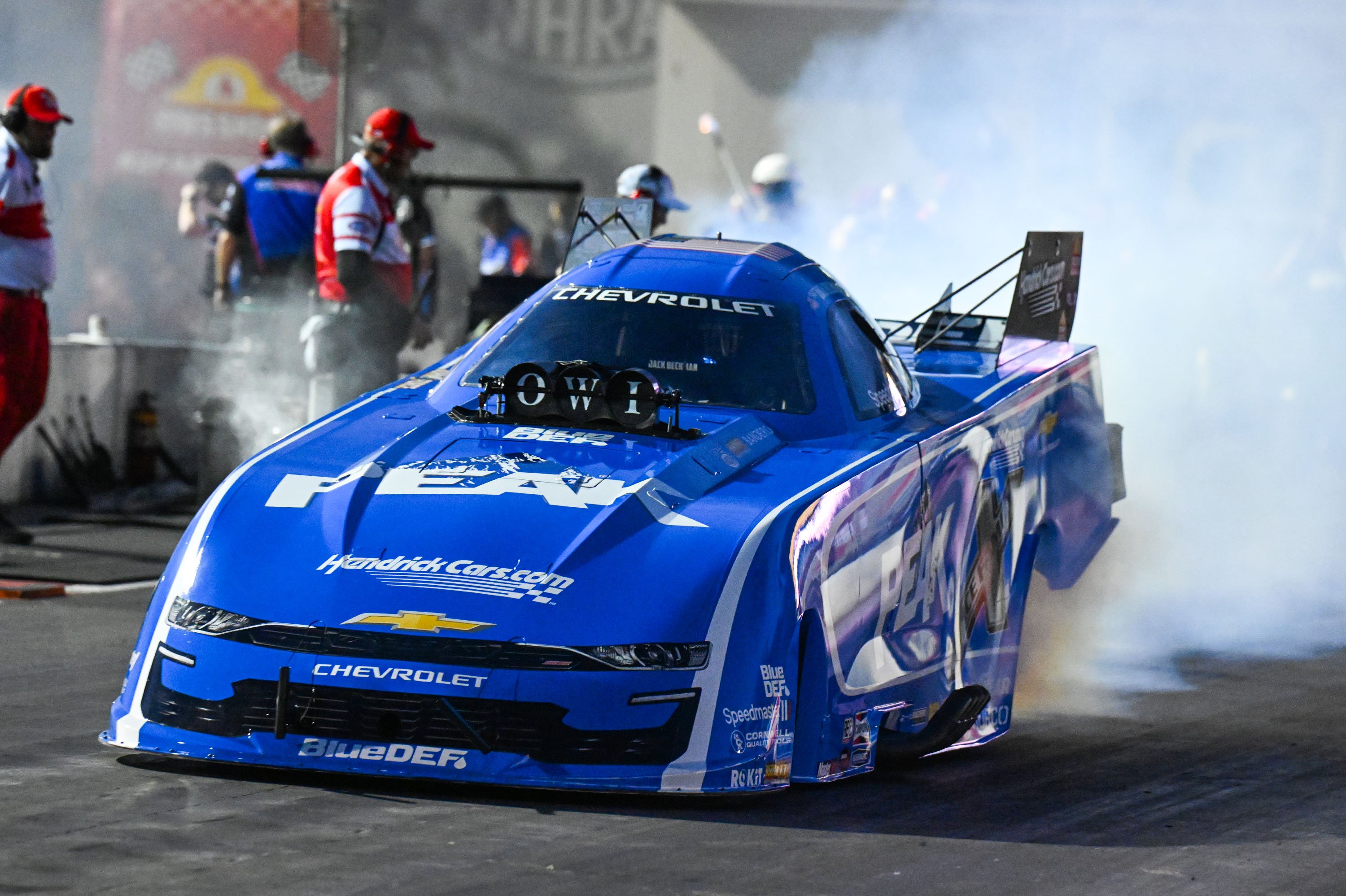
Drag racing has come a long way since thrill-seeking drivers first hit 100 mph in the California dry lake beds. As the automobile has evolved, so has competitive drag racing, resulting in more exciting ways for enthusiasts to participate.
The National Hot Rod Association (NHRA) grew out of a need to solidify safety regulations and to organize meets for drag racers, bringing a level of professionalism to the burgeoning sport. Founded by Hot Rod Magazine editor Wally Parks, the NHRA with its “Safety Safari” worked with local law enforcement and car clubs to organize events at abandoned air strips, creating safe, local races which led to the first NHRA National Championship event in September 1955 at the Grand Bend Municipal Airport in Kansas.
Let’s break down the differences between National Hot Rod Association events and the up-and-coming Drag and Drive circuit — and how fans can experience the best of both worlds.
NHRA Racing
We can all thank Hot Rod Magazine as the driving force behind both NHRA races and Drag and Drive.
Wally Parks first began organizing drag races in 1937, founding the Road Runners Club and leading the Southern California Timing Association, where he would play an instrumental role in the first races “against the clock” at Bonneville Salt Flats.
But Parks’ influence on drag racing would truly begin when he stepped into the editor role at Hot Rod Magazine and founded the National Hot Rod Association in 1951. With this new governing body, drag racing would have distinct rules, performance standards, safety regulations — and, according to Parks, would “create order from chaos.”
Under the NHRA, the popularity of drag racing exploded, leading to an expansion in the competition circuit, upgraded fan experiences at the tracks, and 35,000 licensed competitors.
NHRA Racing Rules and Classifications
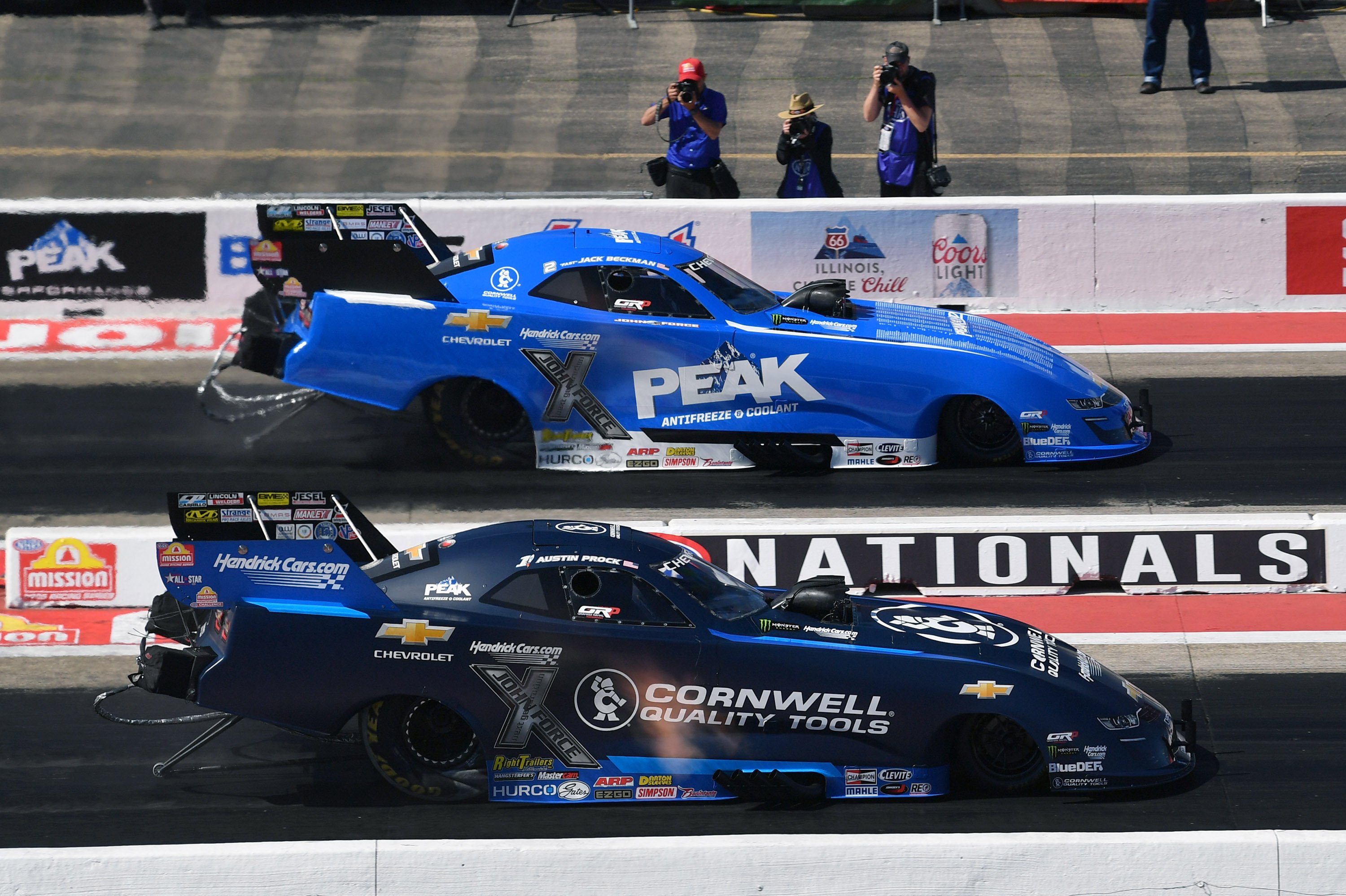
The NHRA still hosts drag events that involve “an acceleration contest between two vehicles over a metered distance.” One car wins and continues in the competition, and the losing vehicle is eliminated.
Heads-Up Categories
Today, those head-to-head competitions feature cars from a single class and are broken into 10 categories, which include:
- Top Fuel
- Funny Car
- Pro Stock
- Pro Stock Motorcycle
- Top Alcohol Dragster
- Top Alcohol Funny Car
- Super Comp
- Super Gas
- Super Street
- Pro Mod
Handicapped Racing
But sometimes, it’s not as straightforward as the first car to the finish wins. In the Comp, Super Stock, and Stock classes, a handicap start system and predetermined indexes mean that completely different classes can compete against each other, and it’s really a competition of reaction time. With the handicap in place, both cars should reach the finish line at the same time, so the driver has to be ready to react as soon as the tree lights up green.
In these classes, drivers are provided with an index for their vehicle, which is the predicted elapsed time for a run. If you exceed your index (commonly referred to as “breaking out”), you may cross the finish line first but still lose the race. If both cars break out, the driver who exceeds their index by the smallest margin is declared the winner, regardless of who finishes first.
The NHRA Fan Experience
Want to experience an exciting day at the tracks? The NHRA hosts 20 annual events in cities across the U.S. where fans and racers converge for a full weekend of high speeds.
At each event, you’ll see racers compete in qualifying events on Friday and Saturday, and the best of the best will enter the elimination rounds on Sunday. These rounds are an all-day affair, so make sure to come prepared with sun protection, earplugs, and blankets for when the sun goes down and the ethereal night sessions begin.
With every NHRA ticket, you also receive a pit pass. If you want to see the frenzy and action of the pits, the NHRA recommends that you watch teams get the work in the 30 minutes after each run. And if you don’t mind missing some of the action, head down to the pits before the cars return from their run to get autographs and pictures with your favorite crews.
Drag and Drive
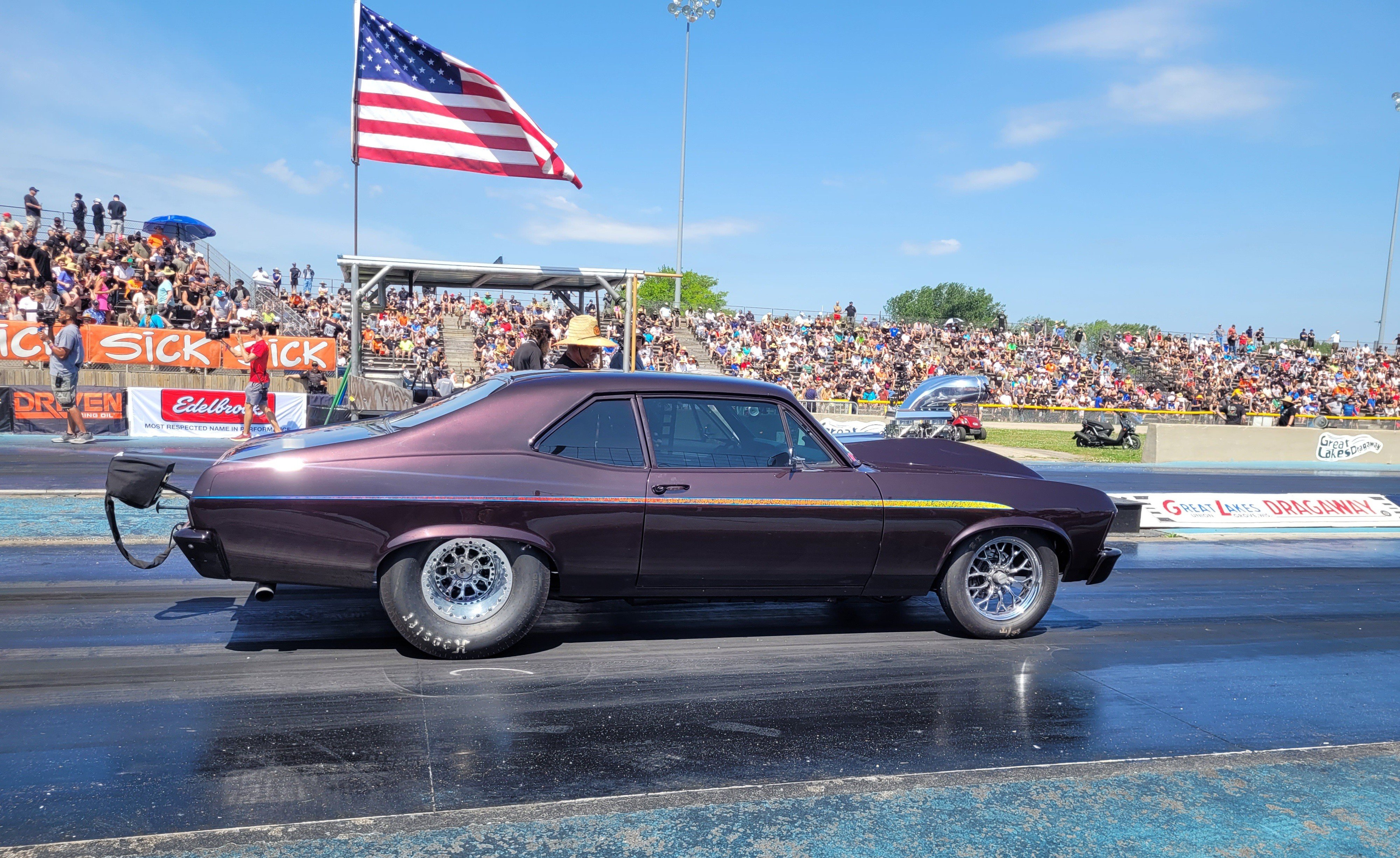
As our friends at the NHRA put it, Drag and Drive is the “grand combination of a road trip adventure and a drag race.” Created by Hot Rod Magazine in 2004, this new twist on drag racing has captured the hearts of competitors and spectators alike. Now, there are over 50 annual events hosted around the globe, like Sick Summer and Speedfest.
The Endurance Challenge
At its heart, Drag and Drive is a test of endurance — not only for the car, but for the teams behind them.
It starts much like any NHRA drag race, with drivers meeting at the tracks to hit high speeds and show off their car’s performance. But then comes the “drive.” Racers pack up their equipment and replace their slicks with street-legal tires before they embark on a road trip to the next race location, following back roads and stopping at checkpoints along the way.
Drag and Drive veteran Emily Reeves knows from experience that these events are all about overcoming adversity. “These are not just plush race events,” says Emily. “These guys and gals are working so hard to even finish these events — not even go fast, just to finish them is an achievement. It's a huge accomplishment.”
Drag and Drive Rules
No two events will follow the exact same rule set, but there are some basic rules that you can expect to see at a Drag and Drive event.
The biggest one: no support vehicles. Each car that enters the competition must drive each leg of the race carrying everything needed for the length of the competition, with only a single-axle cargo trailer to carry spare parts, tools, and supplies. At no point can any competing vehicle be towed, trailered, or pushed.
Once at the tracks, drivers are welcome to share tools and help each other in the spirit of camaraderie, but there shouldn’t be any existing plans to collaborate before the race begins.
Rules and regulations for vehicles vary from race to race and category to category. Check out the 2025 Hot Rod Drag Week rule packet for an example of the potential categories and regulations.
Fan experience at Drag and Drive
Much like the NHRA event experience, Drag and Drive spectators can spend a full day at the track, watching each run from the stands or wandering the pits to meet the racers. But you also have the opportunity to take part in the “road trip” aspect of the event that makes Drag and Drive so special. We recommend that fans follow the drivers’ routes, hang out at checkpoints as each car rolls by, and even spend a day just watching the parade of race vehicles on their journey to the next track.
Sick the Mag has taken the reins in hosting some of the best Drag and Drive events of the year, where hundreds of the fastest cars come together to break records and traverse the country. PEAK is proud to sponsor Sick events, and we hope to see you there!
→ Check out events by Sick the Mag here
Interested in experiencing Drag and Drive for yourself? Look back at our favorite events of last season and start making plans for next year!
Whether you find yourself driving the backroads during a Drag and Drive event or spending a weekend at the tracks for traditional NHRA races, you’re guaranteed to see daring drivers pushing their vehicles to the absolute limit. Join the PEAK Squad to follow all of the action with our favorite drivers. We’ll see you at the track.