
Liquid Cooling in Data Centers: The Case for Heat Transfer Fluid (HTF)
- Industry News
- PEAK, Thermal Charge
- July 15, 2026
Liquid cooling (heat transfer fluid) is the future for data centers. But why? It uses coolant fluids to absorb heat & remove it from server racks. Learn more.

Data centers are a hot topic in the tech world, with mass-scale artificial intelligence (AI) buildouts driving soaring demand for computing capacity. With servers working hard to process huge quantities of data from AI and everything else, things get hot in data centers. Traditional air cooling is struggling to keep pace, and liquid cooling is becoming a popular and practical alternative.
Heat transfer fluid (HTF) is the backbone of multiple liquid cooling strategies, and it's poised to become critically important to the next generation of data centers. Here, we'll look at why liquid cooling is primed to take over from air cooling and the role HTF will play in that transition. We'll cover:
- Why air cooling isn't cutting it anymore
- Liquid cooling strategies and how they work
- HTF's role in liquid cooling
- Performance properties of engineered HTF for data centers
Let's explore the technical and operational factors driving the shift from air cooling to HTF-powered liquid cooling solutions.
Why Air Cooling Isn't Cutting It Anymore
Standard data center air cooling strategies use a technique known as "aisle containment". This approach separates hot exhaust air from cool supply air, allowing engineered airflow pathways to absorb heat from computing equipment and remove it from the facility.
Air cooling has long been the go-to strategy in data centers. Exact figures are hard to come by, but a 2024 analysis estimated that about 80% of data centers still use it. That figure looks set to fall — possibly very quickly — as AI workloads strain data centers beyond their established limits.
The powerful servers used in AI and cloud computing consume enormous quantities of electricity. This generates even more heat than usual, which must be safely removed to avoid hardware damage, data losses, and service outages.
As an added challenge, those servers function in tightly stacked racks that work around the clock. These layouts simply weren't designed with AI computing in mind. Air cooling worked well enough before AI came along, but its viability is quickly slipping away under the relentless pressure of today's workloads.
In late 2025, Reuters reported that cooling needs account for about 40% of all data center energy consumption. Given that bloated figure, air cooling looks increasingly inefficient, ineffective, and costly. Operators are embracing liquid cooling as an alternative: according to Business Insider, liquid cooling solutions have the potential to be up to 3,000 times more efficient than air.
Liquid Cooling Strategies and How They Work
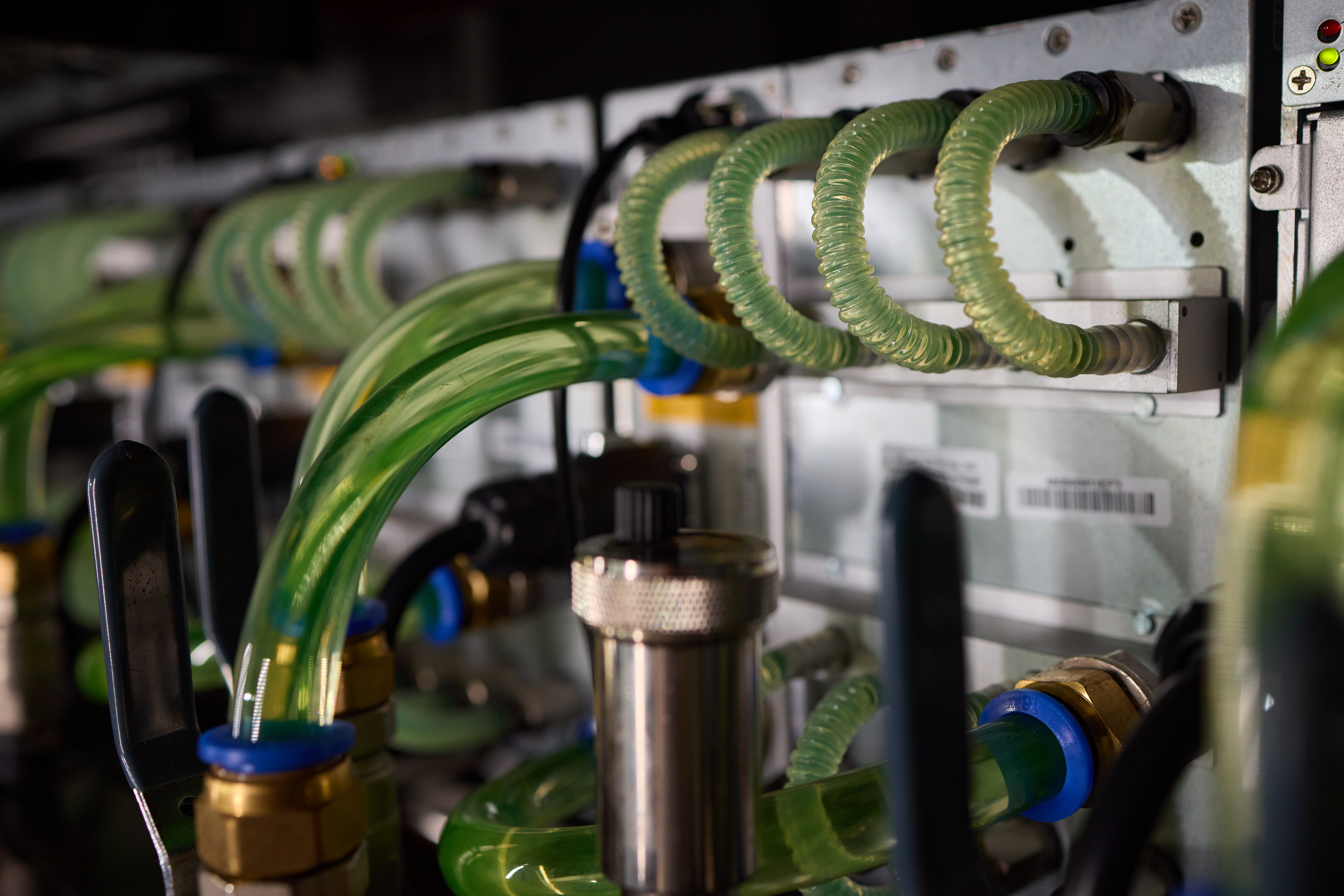
Instead of circulated air, liquid cooling uses coolant fluids to absorb heat and remove it from server racks. Here's a high-level breakdown of how it works:
- Liquid coolants travel to hot computing components, like central processing units (CPUs) and graphics processing units (GPUs), to absorb their heat.
- The heated liquid then moves to a heat exchanger component, where it gets cooled down before recirculating back into the system.
- The heat exchanger ejects collected heat to an external system, which removes it from the facility.
This general model forms the basis of multiple leading liquid cooling strategies, including:
Direct-to-chip (DTC) Cooling
DTC cooling is like giving your CPUs and GPUs a high-tech bath. Heat-generating chips rest atop cold plates infused with coolant fluid, which soaks up the heat the chips create before flowing to a radiator to release it.
The end result: computing hardware stays well within safe operating temperatures without the need for complex and costly airflow management setups.
Immersion Cooling
Immersion cooling bathes server components in a special, non-conductive liquid coolant that soaks up heat and redistributes that heat to a cooling system. The cooled-off fluid then circulates back to absorb more heat, creating a continuous loop that keeps temperatures stable as computer systems operate.
Rear-door Heat Exchangers
Rear-door heat exchangers can be fitted to the back of any standard server rack, collecting hot air from computer systems as it passes over a coil filled with coolant liquid. The coolant then carries the heat away before it has a chance to build up, yielding an efficient solution that also cuts down on space requirements.
Heat Transfer Fluid’s Role in Liquid Cooling
Specially engineered heat transfer fluid plays a major role in liquid cooling for data centers, acting as the conduit for absorbing and removing heat from critical computing components.
Many data center liquid cooling systems use Propylene glycol-based HTF, circulating it through the facility's HVAC infrastructure. From there, it flows to server racks to remove heat via DTC cooling, immersion cooling, rear-door heat exchangers, or other methods.
Here's how glycol-based HTF works:
- The HTF circulates in a closed-loop system, absorbing heat from a source (computer servers, in the case of data centers) by the process of convection.
- Pumps move the heated fluid to a heat-release component, where the HTF transfers the thermal buildup to a cooling element.
- The HTF cools back down as it transfers its heat into the cooling system, then returns to collect more excess heat.
- This process can go on continuously, as long as the HTF retains its performance properties and doesn't become contaminated.
For a more complete explanation of how HTF works, consult this resource on the various types of heat transfer fluids and their industrial applications. You can also review this white paper, which explains the role of HTF in data center climate control.

Performance Properties of Engineered HTF for Data Centers
Propylene Glycol HTF like THERMAL CHARGEⓇ PG25 Heat Transfer Fluid is an excellent choice for liquid cooling in data centers.
THERMAL CHARGE PG25 is specially formulated for data center applications, delivering outstanding thermal performance, advanced corrosion resistance, and excellent freeze protection. Its thermal performance and anticorrosive properties come from the fluid's Propylene glycol / water-based coolant and specially engineered corrosion inhibitor package. Although not expected to operate in freezing environments, THERMAL CHARGE PG25 has a generous freezing point of 12° Fahrenheit (-11° Celsius).
Thanks to these characteristics, THERMAL CHARGE PG25 has excellent cross-system compatibility and reliable chemical stability that makes it well-suited to strong performance across a wide temperature range. With a boiling point of 213°Fahrenheit (101°Celsius), THERMAL CHARGE PG25 retains its performance properties in virtually any data center conditions it might encounter.
Available as a prediluted ready to use formula, THERMAL CHARGE PG25 is powered by propylene glycol and a proprietary inhibitor formula. It's mixed with deionized water to maintain purity and has one of the longest service lifespans of any glycol HTF on the market.
THERMAL CHARGE PG25 is specifically rated for:
- DTC liquid cooling
- Closed-loop cooling systems
- Data center cooling systems
You can save by purchasing THERMAL CHARGE PG25 in bulk or in 55-gallon drums, delivering financial advantages that make liquid cooling an even more efficient and cost-effective solution.
For complete product information, consult this THERMAL CHARGE PG25 spec sheet.